Agent in a Loop: The Simple Pattern Behind Modern AI Agents
By Admin
Introduction
Strip away the hype around "AI agents" and you'll find a surprisingly simple mechanism doing most of the work: a language model wrapped in a loop, repeatedly given a chance to think, act, and observe the results, until it decides the task is done. This pattern — often called the "agent loop" or "agentic loop" — is the foundation underneath coding assistants, research agents, customer support bots, and most of what people mean today when they say "AI agent." This post walks through how the pattern works, why it's powerful, and what to watch out for when building on it.
What "Agent in a Loop" Actually Means
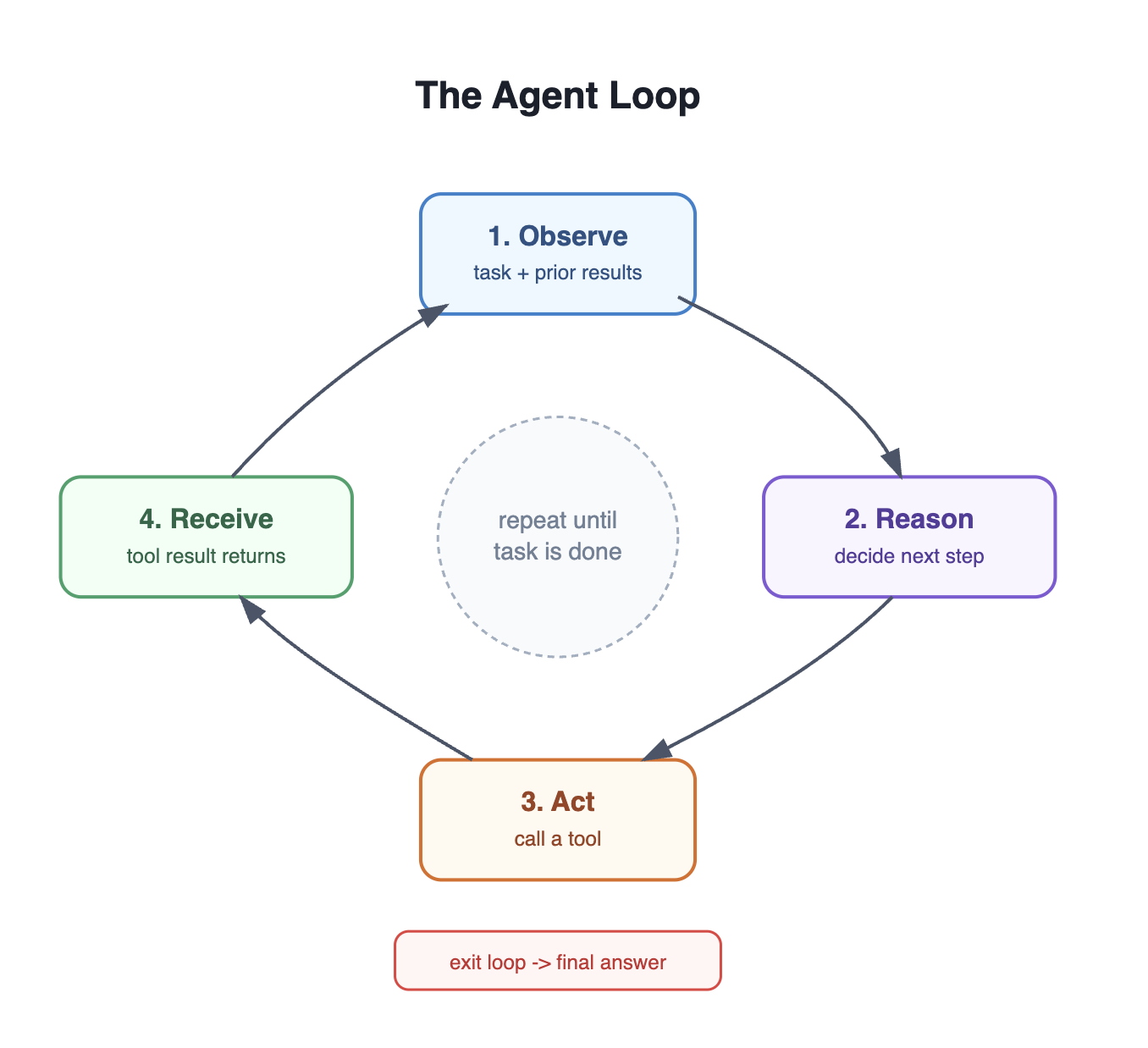
A traditional LLM call is a single request-response pair: you send a prompt, the model replies, and the interaction ends. An agent loop turns that into an ongoing cycle. At each iteration, the model:
- Observes the current state — the original task, prior actions, and their results.
- Reasons about what to do next.
- Acts by calling a tool (searching the web, running code, reading a file, calling an API).
- Receives the result of that action back into its context.
The loop then repeats, feeding the new information back into the model, until it produces a final answer or hits a stopping condition. In pseudocode, it looks roughly like this:
while not done:
    response = model.generate(context)
    if response.wants_tool_call:
        result = execute_tool(response.tool_call)
        context.append(result)
    else:
        done = True
        final_answer = response
That's it. There's no separate "planning module" or hidden reasoning engine — the loop itself, combined with the model's ability to decide what to do next, is what creates agentic behavior.
Why This Pattern Works
A single LLM call is limited to whatever the model can produce from its training data and the text in front of it. It can't look anything up, can't verify its own claims, and can't correct course if it's wrong. The loop changes that by giving the model three things a single call can't offer:
Grounding. Tool calls let the model pull in real, current information — a file's actual contents, a database's actual state, a webpage's actual text — instead of guessing from memory.
Iteration. If a first attempt fails (a command errors out, a search returns nothing useful), the model sees that failure and can try something else. This is fundamentally different from a one-shot answer, which has no chance to self-correct.
Compounding context. Each loop iteration adds to the model's working memory. By the tenth step, the model isn't reasoning from a blank slate — it's reasoning with the accumulated evidence of everything it's already tried and found.
This is why agent loops handle open-ended, multi-step tasks — like "find the bug in this codebase and fix it" or "research three competitors and summarize their pricing" — far better than a single prompt ever could.
The Core Components
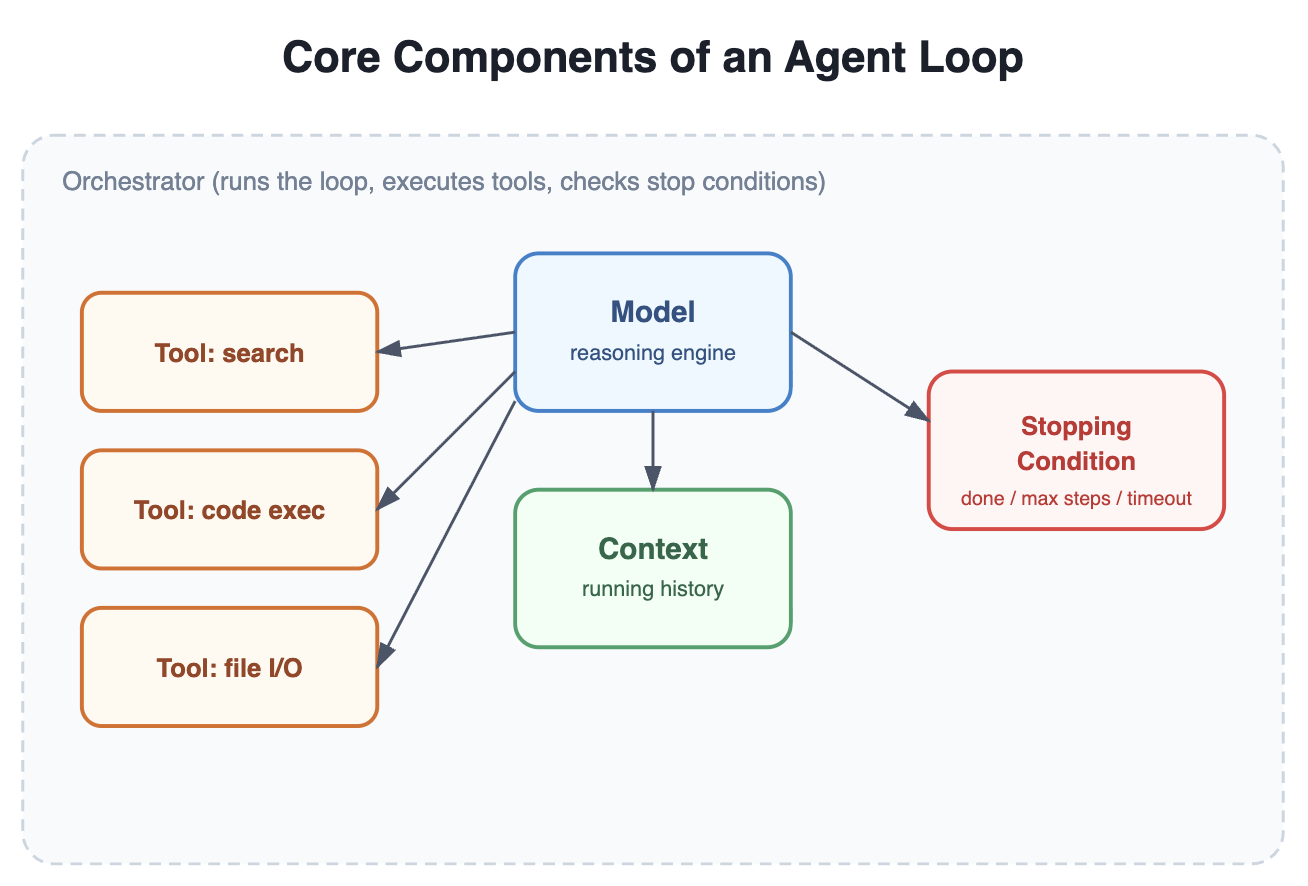
Every agent loop, regardless of framework, is built from the same handful of pieces.
The model is the reasoning engine. At each step it decides whether it has enough information to answer, or whether it needs to call a tool — and if so, which one and with what arguments.
Tools are the model's hands. They're typically defined with a name, a description, and a schema for their inputs, so the model knows what's available and how to use it. Good tool design matters enormously here: a tool with an ambiguous description or poorly specified parameters will get misused no matter how capable the underlying model is.
The context window holds the running history of the task — the original instructions, every tool call, and every result. This is also the loop's main constraint: context windows are finite, so long-running agents need strategies (summarization, pruning, external memory) to avoid drowning in their own history.
The orchestrator is the code around the model that actually executes tool calls, checks stopping conditions, and manages errors. It's often invisible to the end user but does the unglamorous work of keeping the loop stable.
Stopping conditions determine when the loop ends: the model signals it's done, a maximum number of steps is reached, a timeout fires, or a human intervenes. Without a clear stopping condition, a loop can spin indefinitely, burning time and money on unproductive steps.
A Concrete Example
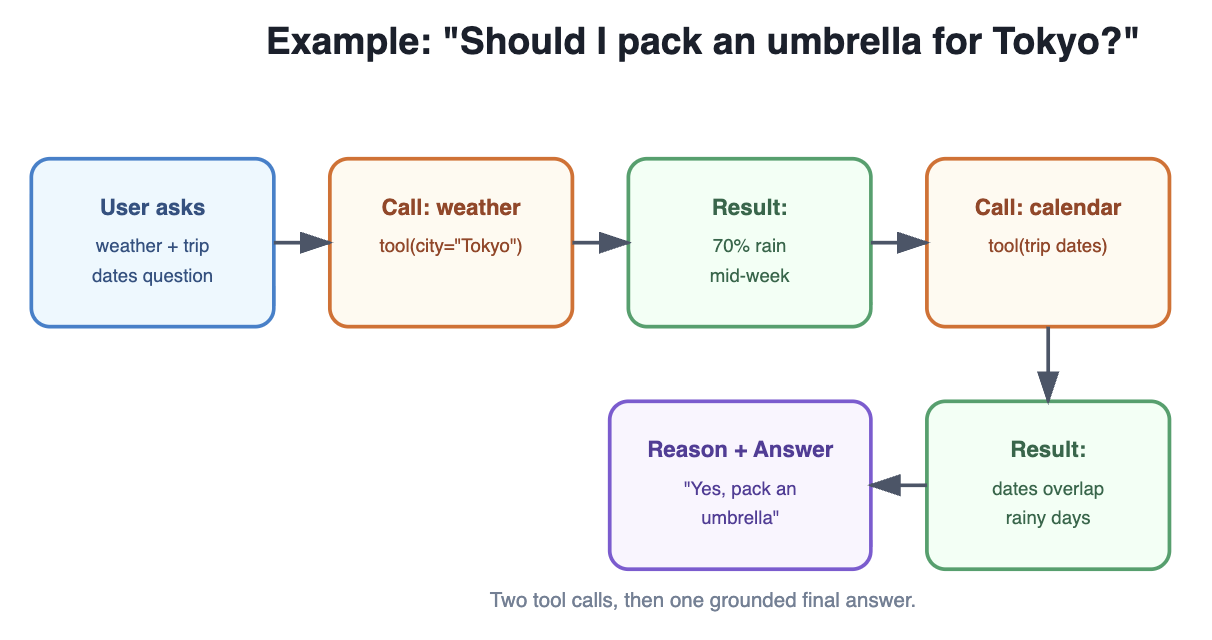
Imagine asking an agent: "What's the current weather in Tokyo, and should I pack an umbrella for my trip next week?"
A single LLM call would have to guess or hallucinate an answer. An agent loop instead might proceed like this: the model recognizes it needs current data and calls a weather tool for Tokyo; the tool returns a forecast; the model reads the forecast, sees a high chance of rain mid-week, and calls a calendar or date tool to confirm which days overlap with the user's trip; it then reasons over both results and produces a final answer — "Yes, pack an umbrella — 70% chance of rain on the days you'll be there." Three steps, two tool calls, one grounded answer.
This is the same basic loop used by coding agents that read a file, run a test, see it fail, edit the code, and rerun the test — just with different tools attached.
Failure Modes and Design Tradeoffs
The pattern is simple, but simple doesn't mean easy to get right. A few recurring problems show up across implementations.
Looping without progress. A model can get stuck retrying a failing action with minor variations, never recognizing that the approach itself is wrong. Good systems detect repeated failures and either change strategy or stop and ask for help.
Context bloat. As the loop runs longer, the accumulated history can crowd out the space needed for reasoning, or bury the original instructions under noise. This is why many agent frameworks periodically summarize or compress older steps.
Tool misuse. If tools are ambiguous, overlapping, or poorly documented, the model will call the wrong one or pass malformed arguments — and every downstream step inherits that mistake.
Cost and latency. Every iteration is a full model call, and multi-step tasks can rack up dozens of calls. This is a real tradeoff against single-shot prompting, which is cheaper and faster when the task doesn't actually need iteration.
Runaway autonomy. The more capable the loop, the more important it is to bound what it's allowed to do unsupervised — file deletions, financial transactions, and irreversible actions generally warrant a human checkpoint rather than full autonomy.
Conclusion
"Agent in a loop" isn't a marketing term for something exotic — it's a precise description of the mechanism: observe, reason, act, observe again, repeat until done. What makes it powerful isn't any single clever trick, but the compounding effect of letting a model gather real information, see the consequences of its own actions, and adjust. Understanding the loop this concretely also makes its failure modes legible: most "agent" bugs trace back to a missing stopping condition, an underspecified tool, or a context window that quietly ran out of room — not some deeper mystery in the model itself.