AI Agents Just Got Good at the Boring Part
By Admin
What actually changed in 2026 — and what it means for the work your team does
For three years, the interesting question about AI was whether the output was any good. That question is largely settled, and it turned out to be the wrong one. The question that matters now is different and much harder to answer from a demo: how much of a workflow can you hand over, and what has to be true before you do?
Something shifted in the last eighteen months. It wasn't a single dramatic capability. It was the accumulation of unglamorous ones — persistence, tool access, error recovery, standard interfaces — that together move AI from producing artifacts to completing tasks.
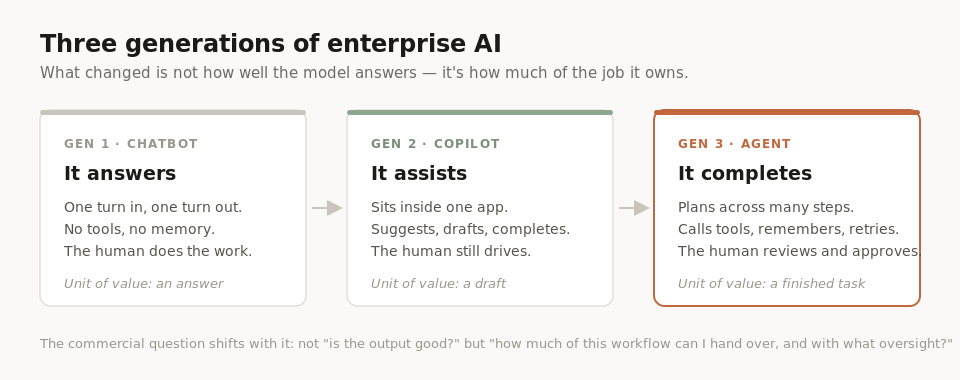
The distinction is commercial, not technical. A copilot makes your analyst faster at building the report. An agent pulls the data, builds the report, notices the anomaly in row 400, checks it against last quarter, and flags it for review. The first is a productivity gain you measure in minutes saved. The second is a change in what a role consists of.
Capability 1: Agents can now hold a task for hours, not minutes
The most useful single metric here comes from METR, an evaluation lab that measures what it calls an agent's time horizon — the length of task, measured by how long a human expert would need, that an agent can complete successfully about half the time.
The trajectory is steep. GPT-2's horizon was roughly two seconds. Claude 3.7 Sonnet reached about 50 minutes. OpenAI's o3 was near two hours. In METR's most recent testing, Opus 4.6 measured around 12 hours.
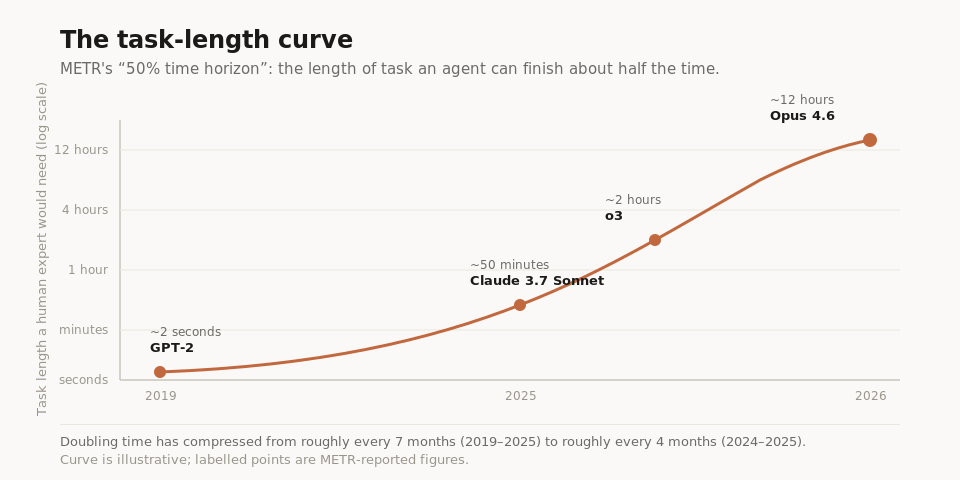
More striking than any point on that curve is its slope. The doubling period ran at roughly seven months from 2019 through 2025, then compressed to roughly four months across 2024–2025.
Two caveats before anyone builds a roadmap on this. First, METR's tasks skew heavily toward software engineering and general reasoning — well-specified problems with checkable answers. Your accounts-payable exception process is messier, and the horizon there is shorter. METR has published its own note on the metric's limitations, and it's worth reading before quoting the number in a board deck. Second, 50% success is not a service level. A task an agent completes half the time is a task that needs a human in the loop.
What the curve does tell you is directional and important: the class of work that can be delegated is expanding on a timescale measured in months, not years. A process you evaluated as "too long and multi-step for an agent" eighteen months ago deserves a fresh look.
Capability 2: Integration stopped being bespoke
The quiet infrastructure story of 2026 is that agent connectivity converged on standards.
Anthropic's Model Context Protocol (MCP), released in late 2024, became the default way agents connect to tools and data — now past 110 million monthly downloads. Google's Agent-to-Agent (A2A) protocol, released in 2025, does the equivalent job for agents coordinating with other agents. Both are now governed under the Linux Foundation. IBM's ACP offers a REST-native alternative.
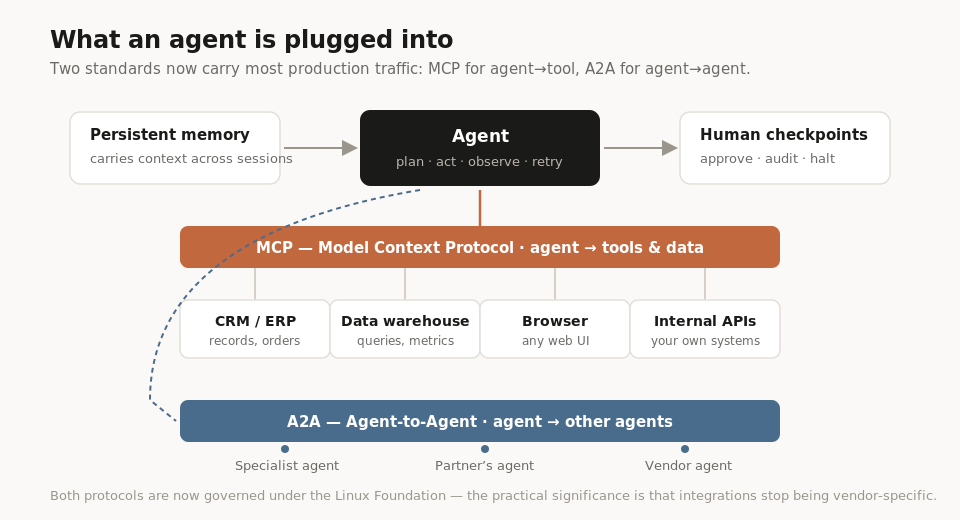
Standards are boring and they are the whole ballgame. Before MCP, every agent-to-system connection was a custom integration you built, owned, and maintained — which meant the cost of connecting an agent to your tenth internal system was roughly the cost of connecting it to your first. After, connectors are reusable across vendors and models. That changes procurement (you are less locked in), it changes build-versus-buy, and it changes the honest estimate for how long a pilot takes to reach production.
It also means agents can now hand work to each other across organizational boundaries. Your fulfillment agent talking to a supplier's inventory agent is a real architecture in 2026, not a slide.
Capability 3: Agents remember
Statelessness was the constraint nobody put on the roadmap because it seemed intrinsic. Every session started cold. The agent that handled a customer's issue in March knew nothing about it in April.
Persistent memory moved from research to production this year. Reported effects — from vendors in the space, so weigh them accordingly — include roughly 47% higher revenue per customer and 3x better retention versus stateless systems, plus around 35% faster resolution times through targeted retrieval.
Treat those figures as directional; they come from companies selling memory layers, and the category is genuinely early. The mechanism, though, is easy to believe. Anyone who has re-explained the same account context to a support system three times understands the value of the system remembering. What is new is that the memory is auditable — you can trace which stored fact drove which decision, which is the difference between a useful feature and one your compliance team will approve.
Capability 4: The interface is now the whole computer
Agents used to need an API for everything they touched. Computer-use and browser-agent capabilities removed that requirement: an agent can operate a web application through its interface the way a person does.
This matters most for the systems you cannot change — the vendor tool with no API, the legacy internal portal, the state government filing site. Benchmarks like OSWorld and WebArena track progress here, and top scores now cluster in the 74–94% range on the easier suites.
Read those scores with real skepticism. Practitioner analysis suggests they run 5–15 points high once you account for benchmark contamination, generous scaffolding, and single-run reporting. A leaderboard is a directional signal, not a contract.
The part the capability story leaves out
Adoption is genuinely strong. More than 57% of enterprises report agents in production, and Gartner expects about 40% of enterprise applications to embed task-specific agents by the end of 2026, up from under 5% at the start of the year.
Now the other column of the ledger.
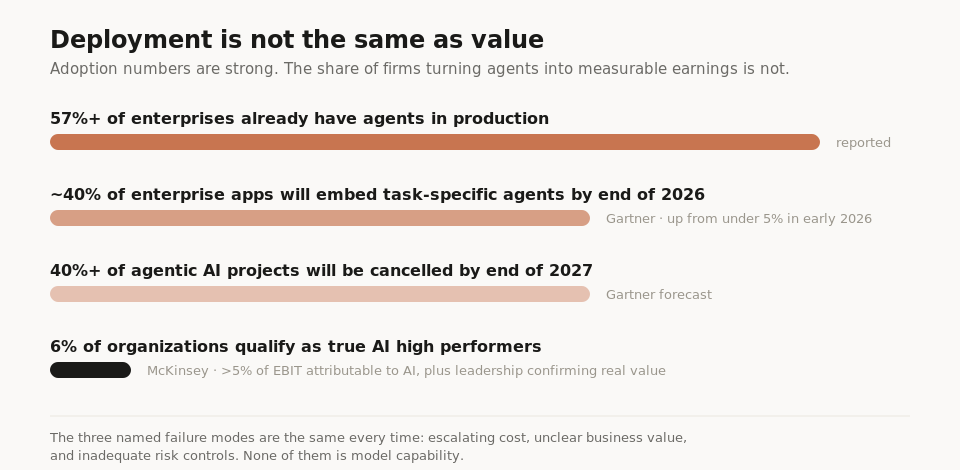
Gartner projects that more than 40% of agentic AI projects will be cancelled by the end of 2027. McKinsey's read is that only about 6% of organizations qualify as genuine AI high performers — its bar being more than 5% of EBIT attributable to AI and leadership reporting significant value delivered.
The named causes are consistent and unromantic: escalating cost, unclear business value, inadequate risk controls. Note that none of them is model capability. The projects failing in 2027 will not fail because the agent couldn't do the task.
What to actually do
Pick processes by shape, not by enthusiasm. The good candidates are high-volume, well-specified, with a checkable output and a bounded cost of being wrong. Invoice reconciliation qualifies. Strategic vendor negotiation does not.
Define the failure budget before the pilot. What is the cost of one wrong action, how do you detect it, and how fast can you reverse it? If you can't answer all three, you are not ready to reduce oversight — and most current deployments keep humans in the loop for exactly this reason.
Instrument for value from day one. The cancelled projects are overwhelmingly the ones that never established a baseline. Measure the before, or you will be arguing about the after.
Assume the horizon keeps moving. Build the review capability, the audit trail, and the reversibility now, while the tasks are small. Those are what let you widen scope safely when the capability arrives — and on current trend, it arrives every few months.
The agents got good at the boring part. The remaining work is also boring, and it's yours: deciding what to hand over, and proving it worked.